Deprecated: Creation of dynamic property WP_Term::$cat_ID is deprecated in /mnt/ceph/home1/util/2/1/21iot3lvu.site.aplus.net/public/wp-includes/category.php on line 378
Deprecated: Creation of dynamic property WP_Term::$category_count is deprecated in /mnt/ceph/home1/util/2/1/21iot3lvu.site.aplus.net/public/wp-includes/category.php on line 379
Deprecated: Creation of dynamic property WP_Term::$category_description is deprecated in /mnt/ceph/home1/util/2/1/21iot3lvu.site.aplus.net/public/wp-includes/category.php on line 380
Deprecated: Creation of dynamic property WP_Term::$cat_name is deprecated in /mnt/ceph/home1/util/2/1/21iot3lvu.site.aplus.net/public/wp-includes/category.php on line 381
Deprecated: Creation of dynamic property WP_Term::$category_nicename is deprecated in /mnt/ceph/home1/util/2/1/21iot3lvu.site.aplus.net/public/wp-includes/category.php on line 382
Deprecated: Creation of dynamic property WP_Term::$category_parent is deprecated in /mnt/ceph/home1/util/2/1/21iot3lvu.site.aplus.net/public/wp-includes/category.php on line 383
Deprecated: Using null as an array offset is deprecated, use an empty string instead in /mnt/ceph/home1/util/2/1/21iot3lvu.site.aplus.net/public/wp-includes/class-wp-block-type-registry.php on line 167
Deprecated: Using null as an array offset is deprecated, use an empty string instead in /mnt/ceph/home1/util/2/1/21iot3lvu.site.aplus.net/public/wp-includes/class-wp-block-type-registry.php on line 167
Deprecated: Using null as an array offset is deprecated, use an empty string instead in /mnt/ceph/home1/util/2/1/21iot3lvu.site.aplus.net/public/wp-includes/class-wp-block-type-registry.php on line 167
Deprecated: Using null as an array offset is deprecated, use an empty string instead in /mnt/ceph/home1/util/2/1/21iot3lvu.site.aplus.net/public/wp-includes/class-wp-block-type-registry.php on line 167
Deprecated: Using null as an array offset is deprecated, use an empty string instead in /mnt/ceph/home1/util/2/1/21iot3lvu.site.aplus.net/public/wp-includes/class-wp-block-type-registry.php on line 167
IRS Internal Revenue Service news IRS issues warning about Corona virus related scams Watch out for scams tied to economic impact payments. The Internal Revenue Service today urged taxpayers to be on the lookout for a surge of calls and email phishing attempts about the corona virus or Cova 19. These contacts can lead to… Continue reading IRS News IRS issues warning about Coronavirus-related scams]]>
Deprecated: Using null as an array offset is deprecated, use an empty string instead in /mnt/ceph/home1/util/2/1/21iot3lvu.site.aplus.net/public/wp-includes/class-wp-block-type-registry.php on line 167
Deprecated: Using null as an array offset is deprecated, use an empty string instead in /mnt/ceph/home1/util/2/1/21iot3lvu.site.aplus.net/public/wp-includes/class-wp-block-type-registry.php on line 167
Deprecated: Using null as an array offset is deprecated, use an empty string instead in /mnt/ceph/home1/util/2/1/21iot3lvu.site.aplus.net/public/wp-includes/class-wp-block-type-registry.php on line 167
IRS Internal Revenue Service news IRS issues warning about Corona virus related scams Watch out for scams tied to economic impact payments. The Internal Revenue Service today urged taxpayers to be on the lookout for a surge of calls and email phishing attempts about the corona virus or Cova 19. These contacts can lead to a tax related fraud and identity theft. Quote, we urge people to take extra care during this period the IRS isn’t going to call you asking to verify or provide your financial information so you can get an economic impact payment or your refund faster in quote.
00:38
So if you get a call or something saying hey, there’s we need to get some information related to this type of payment package, the IRS and it as a general rule, the IRS doesn’t typically call individual taxpayers that’s not typically the way it’s going to work. Typically you’ll get contact through actual mail. So be on the lookout for that there will typically or there will Be phishing attempts most likely here. So that was said by the IRS commissioner Chuck Reddick. Another quote, that also applies to surprise emails that appear to be coming from the IRS.

01:14
Remember, don’t open them or click on attachments or links go to the irs.gov for the most up to date information. So also with the email, obviously, the phishing attempts could happen with the emails as well. And you don’t even want to open the emails because they could have something in them some kind of virus or whatever in the actual email that could infect the computer. So you want to go directly if you get some information from the IRS. Then what you do is you basically if you have any question about it, typically you want to just drop that information don’t return to that particular information go but go directly to the source and then ask them about it.
01:48
So then you contact IRS dot govt go through that type of contact information. And then you can be sure there and check in on it and double check and see if it’s a valid activity or not, but you want to make sure that you go to the source and that’s going to be the IRS govt back to the text. Taxpayers should watch not only for emails but text messages, websites and social media attempts that request money or personal information.

02:14
Quote, history has shown that criminals take every opportunity to perpetuate a fraud on unsuspecting victims, especially when a group of people is vulnerable or in a state of need in quote, said IRS commissioner investigation, Chief Don forte, quote, while we are waiting to hear about your economic impact payment, criminals are working hard to trick you into getting their hands on it. The IRS Criminal Investigation Division is working hard to find these scammers and shut them down. But in the meantime, we ask people to remain vigilant and quote, so we have some kind of stimulus package stimulus, stimulus money going around at this point in time.
02:56 Link to this point in the video
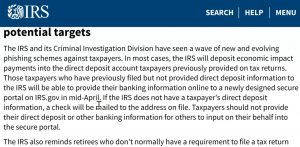
Obviously people that are that might want to have theft going on. see an opportunity with this kind of stimulant pay payments for some type of theft, which also often involves some type of identity theft involved within it. So back to the text don’t fall prey to Corona virus tricks retirees are among potential targets. The IRS has its criminal investigation divisions have seen a wave of new and evolving phishing schemes against taxpayers. In most cases, the IRS will deposit economic impact payments into the Direct Deposit Account taxpayers previously provided on tax returns. Those taxpayers who has previously filed but not provided direct deposit information to the IRS will be able to provide their banking information online to a newly designed secure portal on irs.gov in mid April.
03:47
So in other words, the IRS is really trying to get the direct deposit into the bank accounts for multiple reasons. It can be more secure if you have that direct deposit information but also they can they’re able to do the stimulus package much faster and get the money Out easier so they’re trying to make sure they get a very secure system to have that direct payment and get that get that stimulus money out it back to the text. If the IRS does not have a taxpayers direct deposit information, it check will be mailed to the address on file taxpayer should not provide the direct deposit or other banking information for others to input on their behalf into the secure portal.
04:26
So basically, you want to enter that information into into the portal and not have an agent. Do that or someone else do that. The IRS also reminds retirees who don’t normally have a requirement to file a tax return that no action on their part is needed to receive their $1,200 economic impact payment payment. Seniors should be especially careful during this period. The IRS reminds retirees including recipients of form SS a 1099 and Rb 1099. That no one from the agency will be Reaching out to them by phone, email, mail, or in person asking for any kind of information to complete their economic impact payment. Also, sometimes referred to as rebates or stimulus payments.
05:13
So if you get that kind of that’s going to be a phishing type of email, it’s often email and it’s often going to be phone looking for information. And again, if you get it you got any questions about it, go to the source, go to the irs.gov website and see if you can contact the IRS directly from there to check in on it. So the IRS is sending these 1200 payments automatically to retirees, no additional action or information is needed on their part to receive this. The IRS reminds taxpayers that scammers may emphasize the word stimulus check or stimulus payments.
05:48
So they’re gonna say hey, you know, this is related to your stimulus check, obviously, trying to try to get fishing for information. The official term is economic impact payment, so ask that Ask the taxpayer to sign over their economic impact payment check to them ask by phone, email, text or social media for verification of personal and or banking information saying that the information is needed to receive or speed up their economic impact payment, or suggest that they can get a tax refund or economic impact payment faster by working on the taxpayers behalf. This scam could be conducted by social media or even in person, mail the taxpayer a bogus check, perhaps in an odd amount, then tell the taxpayer to call a number or verify information online in order to cache it. So reporting Corona virus related or other phishing attempts, so the reporting here, those who receive unsolicited emails, text messages or social media attempts to gather information that appear to be from either the IRS or organization closely linked to the IRS, such as the electronic federal tax payment system.
07:00
The eftps should forward it to and there’s going to be a link here but it’s phishing@irs.gov pH I sh i n g at IRS dot govt and then taxpayers are encouraged not to engage potential scammers online or on the phone. Learn more about reporting suspected scams by going to the report fishing and online scams page on irs.gov. There’s a link to that here. You can also find it on IRS dot govt official IRS information about the cobit 19 pandemic and economic impact payments can be found on the current Corona virus tax relief page@irs.gov. So again, if you want information on any kind of relief related to the corona virus, or the Cova 19 you can go to irs.gov and you should find it fairly appropriate you know, in the first part of the page there for it so The page is updated quickly and when new information is available
]]>Deprecated: Creation of dynamic property WP_Term::$cat_ID is deprecated in /mnt/ceph/home1/util/2/1/21iot3lvu.site.aplus.net/public/wp-includes/category.php on line 378
Deprecated: Creation of dynamic property WP_Term::$category_count is deprecated in /mnt/ceph/home1/util/2/1/21iot3lvu.site.aplus.net/public/wp-includes/category.php on line 379
Deprecated: Creation of dynamic property WP_Term::$category_description is deprecated in /mnt/ceph/home1/util/2/1/21iot3lvu.site.aplus.net/public/wp-includes/category.php on line 380
Deprecated: Creation of dynamic property WP_Term::$cat_name is deprecated in /mnt/ceph/home1/util/2/1/21iot3lvu.site.aplus.net/public/wp-includes/category.php on line 381
Deprecated: Creation of dynamic property WP_Term::$category_nicename is deprecated in /mnt/ceph/home1/util/2/1/21iot3lvu.site.aplus.net/public/wp-includes/category.php on line 382
Deprecated: Creation of dynamic property WP_Term::$category_parent is deprecated in /mnt/ceph/home1/util/2/1/21iot3lvu.site.aplus.net/public/wp-includes/category.php on line 383
Deprecated: Using null as an array offset is deprecated, use an empty string instead in /mnt/ceph/home1/util/2/1/21iot3lvu.site.aplus.net/public/wp-includes/class-wp-block-type-registry.php on line 167
Deprecated: Using null as an array offset is deprecated, use an empty string instead in /mnt/ceph/home1/util/2/1/21iot3lvu.site.aplus.net/public/wp-includes/class-wp-block-type-registry.php on line 167
Deprecated: Using null as an array offset is deprecated, use an empty string instead in /mnt/ceph/home1/util/2/1/21iot3lvu.site.aplus.net/public/wp-includes/class-wp-block-type-registry.php on line 167
Deprecated: Using null as an array offset is deprecated, use an empty string instead in /mnt/ceph/home1/util/2/1/21iot3lvu.site.aplus.net/public/wp-includes/class-wp-block-type-registry.php on line 167
Deprecated: Using null as an array offset is deprecated, use an empty string instead in /mnt/ceph/home1/util/2/1/21iot3lvu.site.aplus.net/public/wp-includes/class-wp-block-type-registry.php on line 167
People around the world are celebrating today as International Day of Sign Languages. Taxpayers who sign in American Sign Language can visit YouTube anytime to see IRS ASL videos. The IRS ASL Channel is one of three on YouTube. Each channel offers info about a wide range of tax topics. All the videos on the ASL… Continue reading IRS Tips-IRS offers videos on wide range of tax topics in American Sign Language]]>
Deprecated: Using null as an array offset is deprecated, use an empty string instead in /mnt/ceph/home1/util/2/1/21iot3lvu.site.aplus.net/public/wp-includes/class-wp-block-type-registry.php on line 167
Deprecated: Using null as an array offset is deprecated, use an empty string instead in /mnt/ceph/home1/util/2/1/21iot3lvu.site.aplus.net/public/wp-includes/class-wp-block-type-registry.php on line 167
Deprecated: Using null as an array offset is deprecated, use an empty string instead in /mnt/ceph/home1/util/2/1/21iot3lvu.site.aplus.net/public/wp-includes/class-wp-block-type-registry.php on line 167
People around the world are celebrating today as International Day of Sign Languages. Taxpayers who sign in American Sign Language can visit YouTube anytime to see IRS ASL videos. The IRS ASL Channel is one of three on YouTube. Each channel offers info about a wide range of tax topics.
All the videos on the ASL channel are presented by someone signing in ASL. Each video also includes audio and closed-captioning. The videos appear in several playlists sorted by topic. One of these playlists specifically highlights the services the IRS provides for people who are deaf or hard of hearing. There’s a series of videos in this playlist for ASL interpreters who need to learn appropriate tax terminology in ASL.
Here are other playlists on the IRS Videos in ASL YouTube channel:
- Tax Tips – features videos on general tax topics to help people understand their tax responsibilities.
- ID Theft – includes videos about ID theft that help people recognize scams and know what to do if they think their identity was compromised or stolen.
- Small Business – videos to help business owners find out what tax credit, deduction and law changes may affect their business.
- IRS Tax Pros – playlist featuring videos for and about tax preparers.
More information:
- U.S. Dept. of Health and Human Services: National Institute on Deafness and other Communication Disorders
- NIDCD: American Sign Language
Deprecated: Creation of dynamic property WP_Term::$cat_ID is deprecated in /mnt/ceph/home1/util/2/1/21iot3lvu.site.aplus.net/public/wp-includes/category.php on line 378
Deprecated: Creation of dynamic property WP_Term::$category_count is deprecated in /mnt/ceph/home1/util/2/1/21iot3lvu.site.aplus.net/public/wp-includes/category.php on line 379
Deprecated: Creation of dynamic property WP_Term::$category_description is deprecated in /mnt/ceph/home1/util/2/1/21iot3lvu.site.aplus.net/public/wp-includes/category.php on line 380
Deprecated: Creation of dynamic property WP_Term::$cat_name is deprecated in /mnt/ceph/home1/util/2/1/21iot3lvu.site.aplus.net/public/wp-includes/category.php on line 381
Deprecated: Creation of dynamic property WP_Term::$category_nicename is deprecated in /mnt/ceph/home1/util/2/1/21iot3lvu.site.aplus.net/public/wp-includes/category.php on line 382
Deprecated: Creation of dynamic property WP_Term::$category_parent is deprecated in /mnt/ceph/home1/util/2/1/21iot3lvu.site.aplus.net/public/wp-includes/category.php on line 383
Deprecated: Using null as an array offset is deprecated, use an empty string instead in /mnt/ceph/home1/util/2/1/21iot3lvu.site.aplus.net/public/wp-includes/class-wp-block-type-registry.php on line 167
Deprecated: Using null as an array offset is deprecated, use an empty string instead in /mnt/ceph/home1/util/2/1/21iot3lvu.site.aplus.net/public/wp-includes/class-wp-block-type-registry.php on line 167
Deprecated: Using null as an array offset is deprecated, use an empty string instead in /mnt/ceph/home1/util/2/1/21iot3lvu.site.aplus.net/public/wp-includes/class-wp-block-type-registry.php on line 167
Deprecated: Using null as an array offset is deprecated, use an empty string instead in /mnt/ceph/home1/util/2/1/21iot3lvu.site.aplus.net/public/wp-includes/class-wp-block-type-registry.php on line 167
Deprecated: Using null as an array offset is deprecated, use an empty string instead in /mnt/ceph/home1/util/2/1/21iot3lvu.site.aplus.net/public/wp-includes/class-wp-block-type-registry.php on line 167
IRS Tax Tip 2019-117, August 27, 2019 https://www.irs.gov/newsroom/tax-pros… http://accountinginstruction.info/ Tax professionals should review security steps to make sure they are fully protecting sensitive taxpayer data. All tax pros should give their data safeguards a thorough review. Part of this review is following the “Security Six” protections. Here is more info about these basic protections that… Continue reading IRS Tip – Tax pros: Follow the “Security Six” steps to help]]>
Deprecated: Using null as an array offset is deprecated, use an empty string instead in /mnt/ceph/home1/util/2/1/21iot3lvu.site.aplus.net/public/wp-includes/class-wp-block-type-registry.php on line 167
Deprecated: Using null as an array offset is deprecated, use an empty string instead in /mnt/ceph/home1/util/2/1/21iot3lvu.site.aplus.net/public/wp-includes/class-wp-block-type-registry.php on line 167
Deprecated: Using null as an array offset is deprecated, use an empty string instead in /mnt/ceph/home1/util/2/1/21iot3lvu.site.aplus.net/public/wp-includes/class-wp-block-type-registry.php on line 167
Deprecated: Creation of dynamic property WP_Term::$cat_ID is deprecated in /mnt/ceph/home1/util/2/1/21iot3lvu.site.aplus.net/public/wp-includes/category.php on line 378
Deprecated: Creation of dynamic property WP_Term::$category_count is deprecated in /mnt/ceph/home1/util/2/1/21iot3lvu.site.aplus.net/public/wp-includes/category.php on line 379
Deprecated: Creation of dynamic property WP_Term::$category_description is deprecated in /mnt/ceph/home1/util/2/1/21iot3lvu.site.aplus.net/public/wp-includes/category.php on line 380
Deprecated: Creation of dynamic property WP_Term::$cat_name is deprecated in /mnt/ceph/home1/util/2/1/21iot3lvu.site.aplus.net/public/wp-includes/category.php on line 381
Deprecated: Creation of dynamic property WP_Term::$category_nicename is deprecated in /mnt/ceph/home1/util/2/1/21iot3lvu.site.aplus.net/public/wp-includes/category.php on line 382
Deprecated: Creation of dynamic property WP_Term::$category_parent is deprecated in /mnt/ceph/home1/util/2/1/21iot3lvu.site.aplus.net/public/wp-includes/category.php on line 383
Deprecated: Using null as an array offset is deprecated, use an empty string instead in /mnt/ceph/home1/util/2/1/21iot3lvu.site.aplus.net/public/wp-includes/class-wp-block-type-registry.php on line 167
Deprecated: Using null as an array offset is deprecated, use an empty string instead in /mnt/ceph/home1/util/2/1/21iot3lvu.site.aplus.net/public/wp-includes/class-wp-block-type-registry.php on line 167
Deprecated: Using null as an array offset is deprecated, use an empty string instead in /mnt/ceph/home1/util/2/1/21iot3lvu.site.aplus.net/public/wp-includes/class-wp-block-type-registry.php on line 167
Deprecated: Using null as an array offset is deprecated, use an empty string instead in /mnt/ceph/home1/util/2/1/21iot3lvu.site.aplus.net/public/wp-includes/class-wp-block-type-registry.php on line 167
Deprecated: Using null as an array offset is deprecated, use an empty string instead in /mnt/ceph/home1/util/2/1/21iot3lvu.site.aplus.net/public/wp-includes/class-wp-block-type-registry.php on line 167
IRS Tax Tip 2019-116, August 26, 2019 https://www.irs.gov/newsroom/these-ta… http://accountinginstruction.info/ Starting a business can be very rewarding. It can also be a little overwhelming. From business plans to market strategies, and even tax responsibilities…there are many things to consider. Here’s what new business owners can do to help get off to a good start. Choose a… Continue reading IRS Tax Tips-These tax tips can help new business owners find success]]>
Deprecated: Using null as an array offset is deprecated, use an empty string instead in /mnt/ceph/home1/util/2/1/21iot3lvu.site.aplus.net/public/wp-includes/class-wp-block-type-registry.php on line 167
Deprecated: Using null as an array offset is deprecated, use an empty string instead in /mnt/ceph/home1/util/2/1/21iot3lvu.site.aplus.net/public/wp-includes/class-wp-block-type-registry.php on line 167
Deprecated: Using null as an array offset is deprecated, use an empty string instead in /mnt/ceph/home1/util/2/1/21iot3lvu.site.aplus.net/public/wp-includes/class-wp-block-type-registry.php on line 167
IRS Tax Tip 2019-116, August 26, 2019 https://www.irs.gov/newsroom/these-ta… http://accountinginstruction.info/ Starting a business can be very rewarding. It can also be a little overwhelming. From business plans to market strategies, and even tax responsibilities…there are many things to consider. Here’s what new business owners can do to help get off to a good start. Choose a business structure. The form of business determines which income tax return a business taxpayer needs to file. The most common business structures are: Sole proprietorship: An unincorporated business owned by an individual. There’s no distinction between the taxpayer and their business. Partnership: An unincorporated business with ownership shared between two or more people . Corporation: Also known as a C corporation. It’s a separate entity owned by shareholders. S Corporation: A corporation that elects to pass corporate income, losses, deductions, and credits through to the shareholders. Limited Liability Company: A business structure allowed by state statute. Choose a tax year. A tax year is an annual accounting period for keeping records and reporting income and expenses. A new business owner must choose either: Calendar year: 12 consecutive months beginning January 1 and ending December 31. Fiscal year: 12 consecutive months ending on the last day of any month except December. Apply for an employer identification number. An EIN is also called a federal tax identification number. It’s used to identify a business. Most businesses need an EIN. Have all employees complete these forms: Form I-9, Employment Eligibility Verification (U.S. Citizenship and Immigration Services) (PDF) Form W-4, Employee’s Withholding Allowance Certificate Pay business taxes. The form of business determines what taxes must be paid and how to pay them. Taxpayers interested in starting a business can find information for some industries on the Industries/Professions Tax Centers webpage. Each state has additional requirements for starting and operating a business. Prospective business owners should visit their state’s website for info about state requirements. More information: Small Business Admiration’s 10 steps to start your business
]]>
Deprecated: Creation of dynamic property WP_Term::$cat_ID is deprecated in /mnt/ceph/home1/util/2/1/21iot3lvu.site.aplus.net/public/wp-includes/category.php on line 378
Deprecated: Creation of dynamic property WP_Term::$category_count is deprecated in /mnt/ceph/home1/util/2/1/21iot3lvu.site.aplus.net/public/wp-includes/category.php on line 379
Deprecated: Creation of dynamic property WP_Term::$category_description is deprecated in /mnt/ceph/home1/util/2/1/21iot3lvu.site.aplus.net/public/wp-includes/category.php on line 380
Deprecated: Creation of dynamic property WP_Term::$cat_name is deprecated in /mnt/ceph/home1/util/2/1/21iot3lvu.site.aplus.net/public/wp-includes/category.php on line 381
Deprecated: Creation of dynamic property WP_Term::$category_nicename is deprecated in /mnt/ceph/home1/util/2/1/21iot3lvu.site.aplus.net/public/wp-includes/category.php on line 382
Deprecated: Creation of dynamic property WP_Term::$category_parent is deprecated in /mnt/ceph/home1/util/2/1/21iot3lvu.site.aplus.net/public/wp-includes/category.php on line 383
Deprecated: Using null as an array offset is deprecated, use an empty string instead in /mnt/ceph/home1/util/2/1/21iot3lvu.site.aplus.net/public/wp-includes/class-wp-block-type-registry.php on line 167
Deprecated: Using null as an array offset is deprecated, use an empty string instead in /mnt/ceph/home1/util/2/1/21iot3lvu.site.aplus.net/public/wp-includes/class-wp-block-type-registry.php on line 167
Deprecated: Using null as an array offset is deprecated, use an empty string instead in /mnt/ceph/home1/util/2/1/21iot3lvu.site.aplus.net/public/wp-includes/class-wp-block-type-registry.php on line 167
Deprecated: Using null as an array offset is deprecated, use an empty string instead in /mnt/ceph/home1/util/2/1/21iot3lvu.site.aplus.net/public/wp-includes/class-wp-block-type-registry.php on line 167
Deprecated: Using null as an array offset is deprecated, use an empty string instead in /mnt/ceph/home1/util/2/1/21iot3lvu.site.aplus.net/public/wp-includes/class-wp-block-type-registry.php on line 167
WASHINGTON — The Internal Revenue Service and its Security Summit partners today warned taxpayers and tax professionals about a new IRS impersonation scam campaign spreading nationally on email. Remember: the IRS does not send unsolicited emails and never emails taxpayers about the status of refunds. https://www.irs.gov/newsroom/security… http://accountinginstruction.info/ The IRS this week detected this new scam… Continue reading IRS Warns of New Impersonation Email Scam August 2019]]>
Deprecated: Using null as an array offset is deprecated, use an empty string instead in /mnt/ceph/home1/util/2/1/21iot3lvu.site.aplus.net/public/wp-includes/class-wp-block-type-registry.php on line 167
Deprecated: Using null as an array offset is deprecated, use an empty string instead in /mnt/ceph/home1/util/2/1/21iot3lvu.site.aplus.net/public/wp-includes/class-wp-block-type-registry.php on line 167
Deprecated: Using null as an array offset is deprecated, use an empty string instead in /mnt/ceph/home1/util/2/1/21iot3lvu.site.aplus.net/public/wp-includes/class-wp-block-type-registry.php on line 167
WASHINGTON — The Internal Revenue Service and its Security Summit partners today warned taxpayers and tax professionals about a new IRS impersonation scam campaign spreading nationally on email. Remember: the IRS does not send unsolicited emails and never emails taxpayers about the status of refunds. https://www.irs.gov/newsroom/security… http://accountinginstruction.info/ The IRS this week detected this new scam as taxpayers began notifying phishing@irs.gov about unsolicited emails from IRS imposters. The email subject line may vary, but recent examples use the phrase “Automatic Income Tax Reminder” or “Electronic Tax Return Reminder.” The emails have links that show an IRS.gov-like website with details pretending to be about the taxpayer’s refund, electronic return or tax account. The emails contain a “temporary password” or “one-time password” to “access” the files to submit the refund. But when taxpayers try to access these, it turns out to be a malicious file. “The IRS does not send emails about your tax refund or sensitive financial information,” said IRS Commissioner Chuck Rettig. “This latest scheme is yet another reminder that tax scams are a year-round business for thieves. We urge you to be on-guard at all times.” This new scam uses dozens of compromised websites and web addresses that pose as IRS.gov, making it a challenge to shut down. By infecting computers with malware, these imposters may gain control of the taxpayer’s computer or secretly download software that tracks every keystroke, eventually giving them passwords to sensitive accounts, such as financial accounts. The IRS, state tax agencies and the tax industry, which work together in the Security Summit effort, have made progress in their efforts to fight stolen identity refund fraud. But people remain vulnerable to scams by IRS imposters sending fake emails or harrassing phone calls. The IRS doesn’t initiate contact with taxpayers by email, text messages or social media channels to request personal or financial information. This includes requests for PIN numbers, passwords or similar access information for credit cards, banks or other financial accounts. The IRS also doesn’t call to demand immediate payment using a specific payment method such as a prepaid debit card, gift card or wire transfer. Generally, the IRS will first mail a bill to any taxpayer who owes taxes. See Report Phishing and Online Scams for more details.
]]>
Deprecated: Creation of dynamic property WP_Term::$cat_ID is deprecated in /mnt/ceph/home1/util/2/1/21iot3lvu.site.aplus.net/public/wp-includes/category.php on line 378
Deprecated: Creation of dynamic property WP_Term::$category_count is deprecated in /mnt/ceph/home1/util/2/1/21iot3lvu.site.aplus.net/public/wp-includes/category.php on line 379
Deprecated: Creation of dynamic property WP_Term::$category_description is deprecated in /mnt/ceph/home1/util/2/1/21iot3lvu.site.aplus.net/public/wp-includes/category.php on line 380
Deprecated: Creation of dynamic property WP_Term::$cat_name is deprecated in /mnt/ceph/home1/util/2/1/21iot3lvu.site.aplus.net/public/wp-includes/category.php on line 381
Deprecated: Creation of dynamic property WP_Term::$category_nicename is deprecated in /mnt/ceph/home1/util/2/1/21iot3lvu.site.aplus.net/public/wp-includes/category.php on line 382
Deprecated: Creation of dynamic property WP_Term::$category_parent is deprecated in /mnt/ceph/home1/util/2/1/21iot3lvu.site.aplus.net/public/wp-includes/category.php on line 383
Deprecated: Using null as an array offset is deprecated, use an empty string instead in /mnt/ceph/home1/util/2/1/21iot3lvu.site.aplus.net/public/wp-includes/class-wp-block-type-registry.php on line 167
Deprecated: Using null as an array offset is deprecated, use an empty string instead in /mnt/ceph/home1/util/2/1/21iot3lvu.site.aplus.net/public/wp-includes/class-wp-block-type-registry.php on line 167
Deprecated: Using null as an array offset is deprecated, use an empty string instead in /mnt/ceph/home1/util/2/1/21iot3lvu.site.aplus.net/public/wp-includes/class-wp-block-type-registry.php on line 167
Deprecated: Using null as an array offset is deprecated, use an empty string instead in /mnt/ceph/home1/util/2/1/21iot3lvu.site.aplus.net/public/wp-includes/class-wp-block-type-registry.php on line 167
Deprecated: Using null as an array offset is deprecated, use an empty string instead in /mnt/ceph/home1/util/2/1/21iot3lvu.site.aplus.net/public/wp-includes/class-wp-block-type-registry.php on line 167
Section 1274.–Determination of Issue Price in the Case of Certain Debt Instruments Issued for Property https://www.irs.gov/pub/irs-drop/rr-1… http://accountinginstruction.info/ (Also Sections 42, 280G, 382, 467, 468, 482, 483, 1288, 7520, 7872.) Rev. Rul. 2019-20 This revenue ruling provides various prescribed rates for federal income tax purposes for September 2019 (the current month). Table 1 contains the short-term,… Continue reading Federal Income Tax Rates 2019 – 2020]]>
Deprecated: Using null as an array offset is deprecated, use an empty string instead in /mnt/ceph/home1/util/2/1/21iot3lvu.site.aplus.net/public/wp-includes/class-wp-block-type-registry.php on line 167
Deprecated: Using null as an array offset is deprecated, use an empty string instead in /mnt/ceph/home1/util/2/1/21iot3lvu.site.aplus.net/public/wp-includes/class-wp-block-type-registry.php on line 167
Deprecated: Using null as an array offset is deprecated, use an empty string instead in /mnt/ceph/home1/util/2/1/21iot3lvu.site.aplus.net/public/wp-includes/class-wp-block-type-registry.php on line 167
Section 1274.–Determination of Issue Price in the Case of Certain Debt Instruments Issued for Property https://www.irs.gov/pub/irs-drop/rr-1… http://accountinginstruction.info/ (Also Sections 42, 280G, 382, 467, 468, 482, 483, 1288, 7520, 7872.) Rev. Rul. 2019-20 This revenue ruling provides various prescribed rates for federal income tax purposes for September 2019 (the current month). Table 1 contains the short-term, mid-term, and long-term applicable federal rates (AFR) for the current month for purposes of section 1274(d) of the Internal Revenue Code. Table 2 contains the short-term, mid-term, and long-term adjusted applicable federal rates (adjusted AFR) for the current month for purposes of section 1288(b). Table 3 sets forth the adjusted federal longterm rate and the long-term tax-exempt rate described in section 382(f). Table 4 contains the appropriate percentages for determining the lowincome housing credit described in section 42(b)(1) for buildings placed in service during the current month. However, under section 42(b)(2), the applicable percentage for non-federally subsidized new buildings placed in service after July 30, 2008, shall not be less than 9%. Finally, Table 5 contains the federal rate for determining the present value of an annuity, an interest for life or for a term of years, or a remainder or a reversionary interest for purposes of section 7520. Applicable Federal Rates (AFR) for September 2019 Period for Compounding Annual Semiannual Quarterly Monthly Short-term AFR 1.85% 1.84% 1.84% 1.83% 110% AFR 2.03% 2.02% 2.01% 2.01% 120% AFR 2.22% 2.21% 2.20% 2.20% 130% AFR 2.40% 2.39% 2.38% 2.38% Mid-term AFR 1.78% 1.77% 1.77% 1.76% 110% AFR 1.96% 1.95% 1.95% 1.94% 120% AFR 2.13% 2.12% 2.11% 2.11% 130% AFR 2.31% 2.30% 2.29% 2.29% 150% AFR 2.68% 2.66% 2.65% 2.65% 175% AFR 3.12% 3.10% 3.09% 3.08% Long-term AFR 2.21% 2.20% 2.19% 2.19% 110% AFR 2.43% 2.42% 2.41% 2.41% 120% AFR 2.66% 2.64% 2.63% 2.63% 130% AFR 2.88% 2.86% 2.85% 2.84% Period for Compounding Annual Semiannual Quarterly Monthly Short-term adjusted AFR 1.40% 1.40% 1.40% 1.40% Mid-term adjusted AFR 1.34% 1.34% 1.34% 1.34% Long-term adjusted AFR 1.68% 1.67% 1.67% 1.66% REV. RUL. 2019-20 TABLE 3 Rates Under Section 382 for September 2019 Adjusted federal long-term rate for the current month 1.68% Long-term tax-exempt rate for ownership changes during the current month (the highest of the adjusted federal long-term rates for the current month and the prior two months.) 1.89% REV. RUL. 2019-20 TABLE 4 Appropriate Percentages Under Section 42(b)(1) for September 2019 Note: Under section 42(b)(2), the applicable percentage for non-federally subsidized new buildings placed in service after July 30, 2008, shall not be less than 9%. Appropriate percentage for the 70% present value low-income housing credit 7.46% Appropriate percentage for the 30% present value low-income housing credit 3.20%
]]>
Deprecated: Creation of dynamic property WP_Term::$cat_ID is deprecated in /mnt/ceph/home1/util/2/1/21iot3lvu.site.aplus.net/public/wp-includes/category.php on line 378
Deprecated: Creation of dynamic property WP_Term::$category_count is deprecated in /mnt/ceph/home1/util/2/1/21iot3lvu.site.aplus.net/public/wp-includes/category.php on line 379
Deprecated: Creation of dynamic property WP_Term::$category_description is deprecated in /mnt/ceph/home1/util/2/1/21iot3lvu.site.aplus.net/public/wp-includes/category.php on line 380
Deprecated: Creation of dynamic property WP_Term::$cat_name is deprecated in /mnt/ceph/home1/util/2/1/21iot3lvu.site.aplus.net/public/wp-includes/category.php on line 381
Deprecated: Creation of dynamic property WP_Term::$category_nicename is deprecated in /mnt/ceph/home1/util/2/1/21iot3lvu.site.aplus.net/public/wp-includes/category.php on line 382
Deprecated: Creation of dynamic property WP_Term::$category_parent is deprecated in /mnt/ceph/home1/util/2/1/21iot3lvu.site.aplus.net/public/wp-includes/category.php on line 383
Deprecated: Using null as an array offset is deprecated, use an empty string instead in /mnt/ceph/home1/util/2/1/21iot3lvu.site.aplus.net/public/wp-includes/class-wp-block-type-registry.php on line 167
Deprecated: Using null as an array offset is deprecated, use an empty string instead in /mnt/ceph/home1/util/2/1/21iot3lvu.site.aplus.net/public/wp-includes/class-wp-block-type-registry.php on line 167
Deprecated: Using null as an array offset is deprecated, use an empty string instead in /mnt/ceph/home1/util/2/1/21iot3lvu.site.aplus.net/public/wp-includes/class-wp-block-type-registry.php on line 167
Deprecated: Using null as an array offset is deprecated, use an empty string instead in /mnt/ceph/home1/util/2/1/21iot3lvu.site.aplus.net/public/wp-includes/class-wp-block-type-registry.php on line 167
Deprecated: Using null as an array offset is deprecated, use an empty string instead in /mnt/ceph/home1/util/2/1/21iot3lvu.site.aplus.net/public/wp-includes/class-wp-block-type-registry.php on line 167
IRS Summertime Tips 2019 August http://accountinginstruction.info/ Summertime activities often affect the tax returns people file the following year. Here are some things taxpayers do during the summer along with tips they should consider now: Getting married. Newlyweds should report any name change to the Social Security Administration. They should also report an address change to… Continue reading IRS Summertime Tips 2019 August]]>
Deprecated: Using null as an array offset is deprecated, use an empty string instead in /mnt/ceph/home1/util/2/1/21iot3lvu.site.aplus.net/public/wp-includes/class-wp-block-type-registry.php on line 167
Deprecated: Using null as an array offset is deprecated, use an empty string instead in /mnt/ceph/home1/util/2/1/21iot3lvu.site.aplus.net/public/wp-includes/class-wp-block-type-registry.php on line 167
Deprecated: Using null as an array offset is deprecated, use an empty string instead in /mnt/ceph/home1/util/2/1/21iot3lvu.site.aplus.net/public/wp-includes/class-wp-block-type-registry.php on line 167
IRS Summertime Tips 2019 August http://accountinginstruction.info/ Summertime activities often affect the tax returns people file the following year. Here are some things taxpayers do during the summer along with tips they should consider now: Getting married. Newlyweds should report any name change to the Social Security Administration. They should also report an address change to the United States Postal Service, their employers, and the IRS. This will help make sure they receive documents and other items they will need to file their taxes. Sending kids to summer day camp. Unlike overnight camps, the cost of summer day camp may count towards the child and dependent care credit. Working part-time. While summertime and part-time workers may not earn enough to owe federal income tax, they should remember to file a return. They’ll need to file early next year to get a refund for taxes withheld from their checks this year. Normally, employees receive a Form W-2, Wage and Tax Statement, from their employer to account for the summer’s work. They’ll use this to prepare their tax return. They should receive the W-2 by January 31 next year. Employees will get a W-2 even if they no longer work for the summertime employer. Summertime workers can avoid higher tax bills and lost benefits if they know their correct status. Employers will determine whether the people who work for them are employees or independent contractors. Independent contractors aren’t subject to withholding, making them responsible for paying their own income taxes plus Social Security and Medicare taxes
]]>Deprecated: Creation of dynamic property WP_Term::$cat_ID is deprecated in /mnt/ceph/home1/util/2/1/21iot3lvu.site.aplus.net/public/wp-includes/category.php on line 378
Deprecated: Creation of dynamic property WP_Term::$category_count is deprecated in /mnt/ceph/home1/util/2/1/21iot3lvu.site.aplus.net/public/wp-includes/category.php on line 379
Deprecated: Creation of dynamic property WP_Term::$category_description is deprecated in /mnt/ceph/home1/util/2/1/21iot3lvu.site.aplus.net/public/wp-includes/category.php on line 380
Deprecated: Creation of dynamic property WP_Term::$cat_name is deprecated in /mnt/ceph/home1/util/2/1/21iot3lvu.site.aplus.net/public/wp-includes/category.php on line 381
Deprecated: Creation of dynamic property WP_Term::$category_nicename is deprecated in /mnt/ceph/home1/util/2/1/21iot3lvu.site.aplus.net/public/wp-includes/category.php on line 382
Deprecated: Creation of dynamic property WP_Term::$category_parent is deprecated in /mnt/ceph/home1/util/2/1/21iot3lvu.site.aplus.net/public/wp-includes/category.php on line 383
Deprecated: Using null as an array offset is deprecated, use an empty string instead in /mnt/ceph/home1/util/2/1/21iot3lvu.site.aplus.net/public/wp-includes/class-wp-block-type-registry.php on line 167
Deprecated: Using null as an array offset is deprecated, use an empty string instead in /mnt/ceph/home1/util/2/1/21iot3lvu.site.aplus.net/public/wp-includes/class-wp-block-type-registry.php on line 167
Deprecated: Using null as an array offset is deprecated, use an empty string instead in /mnt/ceph/home1/util/2/1/21iot3lvu.site.aplus.net/public/wp-includes/class-wp-block-type-registry.php on line 167
Deprecated: Using null as an array offset is deprecated, use an empty string instead in /mnt/ceph/home1/util/2/1/21iot3lvu.site.aplus.net/public/wp-includes/class-wp-block-type-registry.php on line 167
Deprecated: Using null as an array offset is deprecated, use an empty string instead in /mnt/ceph/home1/util/2/1/21iot3lvu.site.aplus.net/public/wp-includes/class-wp-block-type-registry.php on line 167
Playlist http://bit.ly/2MullRX 0:26 Payroll Introduction http://bit.ly/2YxXJSW 6:29 Regular & Overtime Pay Calculation http://bit.ly/2YhusNa 11:40 Federal Income Tax FIT http://bit.ly/2YdqxRr 18:54 Payroll Legislation http://bit.ly/2ynPwSG 26:47 Payroll Consideration and Tax Forms http://bit.ly/330xrIy 43:06 Payroll Periods and Time Frames http://bit.ly/2Gyjvfh 50:11 New Employee Tax Forms & Contractor vs Employee http://bit.ly/2MBHEFJ 1:07:26 Federal Income Tax FIT – Percent Method… Continue reading Payroll Accounting]]>
Deprecated: Using null as an array offset is deprecated, use an empty string instead in /mnt/ceph/home1/util/2/1/21iot3lvu.site.aplus.net/public/wp-includes/class-wp-block-type-registry.php on line 167
Deprecated: Using null as an array offset is deprecated, use an empty string instead in /mnt/ceph/home1/util/2/1/21iot3lvu.site.aplus.net/public/wp-includes/class-wp-block-type-registry.php on line 167
Deprecated: Using null as an array offset is deprecated, use an empty string instead in /mnt/ceph/home1/util/2/1/21iot3lvu.site.aplus.net/public/wp-includes/class-wp-block-type-registry.php on line 167
Playlist http://bit.ly/2MullRX 0:26 Payroll Introduction http://bit.ly/2YxXJSW 6:29 Regular & Overtime Pay Calculation http://bit.ly/2YhusNa 11:40 Federal Income Tax FIT http://bit.ly/2YdqxRr 18:54 Payroll Legislation http://bit.ly/2ynPwSG 26:47 Payroll Consideration and Tax Forms http://bit.ly/330xrIy 43:06 Payroll Periods and Time Frames http://bit.ly/2Gyjvfh 50:11 New Employee Tax Forms & Contractor vs Employee http://bit.ly/2MBHEFJ 1:07:26 Federal Income Tax FIT – Percent Method http://bit.ly/2KdIhlX 1:15:09 Federal Income Contributions Act (FICA) http://bit.ly/3100GJA 1:23:15 Social Security Tax Calculation http://bit.ly/2yqpFd2 1:29:25 FUTA, SUTA Workers Compensation http://bit.ly/315gASW 1:34:18 Medicare Tax Calculation http://bit.ly/333BB2o 1:37:49 Federal Unemployment Tax Act Calculation http://bit.ly/2MsXfXV 1:41:32 Payroll Ethics & Practices http://bit.ly/2Kd5SDa 1:50:00 Employer Taxes Calculation http://bit.ly/2yrvnes 1:57:19 Employer Responsibilities and Processes http://bit.ly/30YAlvA 2:05:10 Payroll Expense Journal Entry http://bit.ly/2MtUJRc 2:15:50 Payroll Tax Expense Journal Entry http://bit.ly/2ZpJQ6A 2:24:07 Pay Payroll Tax Expense Journal Entry http://bit.ly/2SZqrqQ 2:32:58 Form 941 Payroll Controls and Documentation http://bit.ly/2ylSuqX 2:55:39 Form 940 http://bit.ly/331dxNB 3:07:14 Form W-3 & W-2 http://bit.ly/2GDGiGv 3:19:11 Reconciling Year End Payroll Forms http://bit.ly/2Mrwran 3:28:30 Minimum Wage & Nonexempt Employees http://bit.ly/2K6Rhuj 3:34:03 Payroll Calculations http://bit.ly/2GDIxcL 3:40:16 Overtime Calculation http://bit.ly/2K4fzFd 3:49:43 Payroll Register http://bit.ly/2LTpGPg 3:59:24 Fringe Benefits http://bit.ly/2SSxGAz 4:05:32 Deductions From Gross Pay http://bit.ly/316pD6k 4:11:55 Retirement Plans http://bit.ly/2K6MPLO 4:21:11 Post Tax Deductions http://bit.ly/2YxnPkQ 4:26:33 Net Pay Calculation http://bit.ly/2LO3AgY 4:31:55 Federal Income Tax (FIT) http://bit.ly/2KdIoxH 4:46:43 Social Security http://bit.ly/2LQzSYM 4:58:18 Medicare Tax http://bit.ly/2YwqvTV 5:04:21 Other Deductions & Payment Methods http://bit.ly/333CesM 5:12:29 605 Taxes Employer Employee http://bit.ly/2Ow8SjB 5:21:50 FICA Employer http://bit.ly/2LQRWCd 5:26:47 Form 941 http://bit.ly/2K65d7W 5:38:44 Form 940 http://bit.ly/2yr5nzY 5:47:35 Form W-3 http://bit.ly/2KeVURU This financial accounting and payroll video will cover payroll topics including payroll legislation, payroll calculations, and entering payroll journal entries. Because payroll is becoming more complex and more of a specialized field it is difficult to find content that puts it all together in one spot like this course does. We will discuss payroll legislation, going over a wide variety of laws that influence payroll. Because payroll is such a broad topic and because it overlaps with other areas of business like human resources many laws influence the processing of payroll. We will concentrate on laws that deal with the calculation of payroll and payroll withholdings. The video will cover the generation of payroll registers and earnings reports, the primary tools to help us calculate payroll. We will discuss how to calculation payroll tax withholding like federal income tax (FIT), social security, and Medicare. We will calculate net pay from gross pay. This video will cover journal entries related to payroll; a topic often overlooked in may payroll classes. Payroll journal entries can be complicated. Learning payroll journal entries helps our understanding of both payroll and debits and credit. We will post payroll journal entries to the general ledger and analyses the effect on the financial accounts and accounting equation. This video will cover the processing of payroll tax forms like form 941, form 940, form W-2, form W-3, and form W-4. We also include a comprehensive a problem, allowing us to see the entire process in one problem. This video includes key terms and definitions related to payroll and a general comprehensive accounting cycle comprehensive problem. The accounting cycle comprehensive problem will take a step back, so we can see the big picture and visualize how the payroll process fits into the overall accounting cycle.
]]>
Deprecated: Creation of dynamic property WP_Term::$cat_ID is deprecated in /mnt/ceph/home1/util/2/1/21iot3lvu.site.aplus.net/public/wp-includes/category.php on line 378
Deprecated: Creation of dynamic property WP_Term::$category_count is deprecated in /mnt/ceph/home1/util/2/1/21iot3lvu.site.aplus.net/public/wp-includes/category.php on line 379
Deprecated: Creation of dynamic property WP_Term::$category_description is deprecated in /mnt/ceph/home1/util/2/1/21iot3lvu.site.aplus.net/public/wp-includes/category.php on line 380
Deprecated: Creation of dynamic property WP_Term::$cat_name is deprecated in /mnt/ceph/home1/util/2/1/21iot3lvu.site.aplus.net/public/wp-includes/category.php on line 381
Deprecated: Creation of dynamic property WP_Term::$category_nicename is deprecated in /mnt/ceph/home1/util/2/1/21iot3lvu.site.aplus.net/public/wp-includes/category.php on line 382
Deprecated: Creation of dynamic property WP_Term::$category_parent is deprecated in /mnt/ceph/home1/util/2/1/21iot3lvu.site.aplus.net/public/wp-includes/category.php on line 383
Deprecated: Using null as an array offset is deprecated, use an empty string instead in /mnt/ceph/home1/util/2/1/21iot3lvu.site.aplus.net/public/wp-includes/class-wp-block-type-registry.php on line 167
Deprecated: Using null as an array offset is deprecated, use an empty string instead in /mnt/ceph/home1/util/2/1/21iot3lvu.site.aplus.net/public/wp-includes/class-wp-block-type-registry.php on line 167
Deprecated: Using null as an array offset is deprecated, use an empty string instead in /mnt/ceph/home1/util/2/1/21iot3lvu.site.aplus.net/public/wp-includes/class-wp-block-type-registry.php on line 167
Deprecated: Using null as an array offset is deprecated, use an empty string instead in /mnt/ceph/home1/util/2/1/21iot3lvu.site.aplus.net/public/wp-includes/class-wp-block-type-registry.php on line 167
Deprecated: Using null as an array offset is deprecated, use an empty string instead in /mnt/ceph/home1/util/2/1/21iot3lvu.site.aplus.net/public/wp-includes/class-wp-block-type-registry.php on line 167
The Accounting Closing Process Playlist http://bit.ly/2GDpYFT 0:27 Closing Process Explained http://bit.ly/2ysr0jr 7:14 Post Closing Trial Balance http://bit.ly/2ZlyHnl 11:19 One Step Closing Process http://bit.ly/2K6cAMx 23:09 Two Step Closing Process http://bit.ly/2Yz8r7E 34:03 Closing Process Step 1 of 4 – Journal Entry 1 of 4 http://bit.ly/2LPRDHF 37:23 Closing Step 2 of 4 – Journal Entry 2 of 4… Continue reading Closing Entries]]>
Deprecated: Using null as an array offset is deprecated, use an empty string instead in /mnt/ceph/home1/util/2/1/21iot3lvu.site.aplus.net/public/wp-includes/class-wp-block-type-registry.php on line 167
Deprecated: Using null as an array offset is deprecated, use an empty string instead in /mnt/ceph/home1/util/2/1/21iot3lvu.site.aplus.net/public/wp-includes/class-wp-block-type-registry.php on line 167
Deprecated: Using null as an array offset is deprecated, use an empty string instead in /mnt/ceph/home1/util/2/1/21iot3lvu.site.aplus.net/public/wp-includes/class-wp-block-type-registry.php on line 167
The Accounting Closing Process Playlist http://bit.ly/2GDpYFT 0:27 Closing Process Explained http://bit.ly/2ysr0jr 7:14 Post Closing Trial Balance http://bit.ly/2ZlyHnl 11:19 One Step Closing Process http://bit.ly/2K6cAMx 23:09 Two Step Closing Process http://bit.ly/2Yz8r7E 34:03 Closing Process Step 1 of 4 – Journal Entry 1 of 4 http://bit.ly/2LPRDHF 37:23 Closing Step 2 of 4 – Journal Entry 2 of 4 http://bit.ly/2YBXKVS 42:41 Closing Entries Journal Entry 3 of 4 Step 3 Income summary http://bit.ly/2K8xvNy 47:39 Closing Process Step 4 of 4 Closing Journal Entry Draws or Withdraws http://bit.ly/2Yfq6WF 1:01:29 Post Closing Trial Balance & financial statements http://bit.ly/2OE9FyG The financial accounting closing process is the final step in the accounting cycle. We will learn why the closing process in needed and be able to perform the closing process multiple ways. As indicated by the title, the closing process takes place at the end of the accounting cycle. The main event of the accounting cycle is the financial statements. Once we have completed the financial statements we need to get ready for the next accounting period, get ready with the closing process. The closing process will zero out temporary accounts including income statement accounts of revenue and expenses and the draws or dividends account. We can perform the closing process multiple ways. We will consider the closing process from three perspectives. Each perspective has pros and cons and the repetition of each method as well as performing the closing process from multiple angles will provide a solid understanding of the concepts. Understanding the closing process helps understand the concept of temporary accounts and permanent accounts, which helps us understand the relationship of the financial statements and how to read them.
]]>
Deprecated: Creation of dynamic property WP_Term::$cat_ID is deprecated in /mnt/ceph/home1/util/2/1/21iot3lvu.site.aplus.net/public/wp-includes/category.php on line 378
Deprecated: Creation of dynamic property WP_Term::$category_count is deprecated in /mnt/ceph/home1/util/2/1/21iot3lvu.site.aplus.net/public/wp-includes/category.php on line 379
Deprecated: Creation of dynamic property WP_Term::$category_description is deprecated in /mnt/ceph/home1/util/2/1/21iot3lvu.site.aplus.net/public/wp-includes/category.php on line 380
Deprecated: Creation of dynamic property WP_Term::$cat_name is deprecated in /mnt/ceph/home1/util/2/1/21iot3lvu.site.aplus.net/public/wp-includes/category.php on line 381
Deprecated: Creation of dynamic property WP_Term::$category_nicename is deprecated in /mnt/ceph/home1/util/2/1/21iot3lvu.site.aplus.net/public/wp-includes/category.php on line 382
Deprecated: Creation of dynamic property WP_Term::$category_parent is deprecated in /mnt/ceph/home1/util/2/1/21iot3lvu.site.aplus.net/public/wp-includes/category.php on line 383
Deprecated: Using null as an array offset is deprecated, use an empty string instead in /mnt/ceph/home1/util/2/1/21iot3lvu.site.aplus.net/public/wp-includes/class-wp-block-type-registry.php on line 167
Deprecated: Using null as an array offset is deprecated, use an empty string instead in /mnt/ceph/home1/util/2/1/21iot3lvu.site.aplus.net/public/wp-includes/class-wp-block-type-registry.php on line 167
Deprecated: Using null as an array offset is deprecated, use an empty string instead in /mnt/ceph/home1/util/2/1/21iot3lvu.site.aplus.net/public/wp-includes/class-wp-block-type-registry.php on line 167
Deprecated: Using null as an array offset is deprecated, use an empty string instead in /mnt/ceph/home1/util/2/1/21iot3lvu.site.aplus.net/public/wp-includes/class-wp-block-type-registry.php on line 167
Deprecated: Using null as an array offset is deprecated, use an empty string instead in /mnt/ceph/home1/util/2/1/21iot3lvu.site.aplus.net/public/wp-includes/class-wp-block-type-registry.php on line 167
Accounting Major Second Guessing & Dealing With Criticisms http://accountinginstruction.info/ Objectives Work with different points of view, take what is helpful, and discard the noise. (Not designed to increase argument but possibly facilitate more productive debate). Help structure personal goals and use doubts constructively In this presentation we’re going to take a look at a problem… Continue reading Accounting Major Second Guessing & Dealing With Criticisms]]>
Deprecated: Using null as an array offset is deprecated, use an empty string instead in /mnt/ceph/home1/util/2/1/21iot3lvu.site.aplus.net/public/wp-includes/class-wp-block-type-registry.php on line 167
Deprecated: Using null as an array offset is deprecated, use an empty string instead in /mnt/ceph/home1/util/2/1/21iot3lvu.site.aplus.net/public/wp-includes/class-wp-block-type-registry.php on line 167
Deprecated: Using null as an array offset is deprecated, use an empty string instead in /mnt/ceph/home1/util/2/1/21iot3lvu.site.aplus.net/public/wp-includes/class-wp-block-type-registry.php on line 167
Accounting Major Second Guessing & Dealing With Criticisms http://accountinginstruction.info/ Objectives Work with different points of view, take what is helpful, and discard the noise. (Not designed to increase argument but possibly facilitate more productive debate). Help structure personal goals and use doubts constructively In this presentation we’re going to take a look at a problem from the perspective of an accounting major. Someone who is going to school and has chosen accounting as their primary field. Although we’re talking here to people that have chosen accounting and are in school for accounting, the same kind of thing applies to people that are working within the accounting field and more broadly basically any type of career choice or career path will apply or at least some of these items will apply to it, that problem being the second guessing of the major that we have chosen and dealing with some type of criticism with regards to the major, debate about the major that has been chosen, either from other students or from instructors or from other individuals that we are involved with Now we’re assuming at this point in time we’re thinking about someone who has basically chosen which path they want to go on. Note typically if someone’s going through say high school or undergraduate then we’re talking to a whole bunch of people trying to decide what’s an appropriate major what’s going to be a good major. At some point in time the decisions going to be made and we have to basically go into that process and continue with the decision making process and move forward with whatever decision we have been chosen. Typically at this point we’re thinking about people who have chosen accounting as their major and now are thinking about moving forward in accounting. Note that as you choose a major, as you narrow things down, as you have to do, it can be concerning because we often think about the things that we have given up That’s of just the way the mind is wired. We’re mentally set to be more concerned about the things that we’ve lost than the things that we’re going to gain. With regards to the choices that we make as we go into the choice usually we find that the choice that we have made and the more we think about the choice we’ve made then there’s basically infinite possibilities we have within that choice that we’ve made. We still have a tons of choices to make. Most people don’t narrow down enough and have too many choices and they end up basically getting stuck at a standstill. Business, Economics, & Practical Technical Skills questions: Accounting is not where the money is at Wake up and go where the action is Accounting will be completely automated someday Your job will be outsourced Accounting is not an integral part of the business model but just a miner task that need to be done, similar to the trash needing to be taken out Real business people focus on the money making components and higher somebody do accounting. Accounting is not the fun part of business. Marketing and advertising is where the fun is. Arts and Humanities Life activities should be focused on what you love doing. Who could love doing accounting? Money doesn’t really matter. Why focus so much time counting it? Life should be spent doing stuff and interacting with people. Why spend so much time working on number, ledgers, and with computers Sciences qeustions Life is about understanding the physical world. Money is just a tool that should be used towards this end As we learn accounting, we should be integrating these other areas as we can Whatever career we choose can be thought of as a focal point we use to build on. Whatever we know best will eventually lead into other topics as we expand out knowledge. As students we can expand our knowledge by learning components of other disciplines that most directly apply to ours Learn accounting software. Learn databases Learn tax software Learn managerial concepts, group dynamics, and economics
]]>